[ad_1]
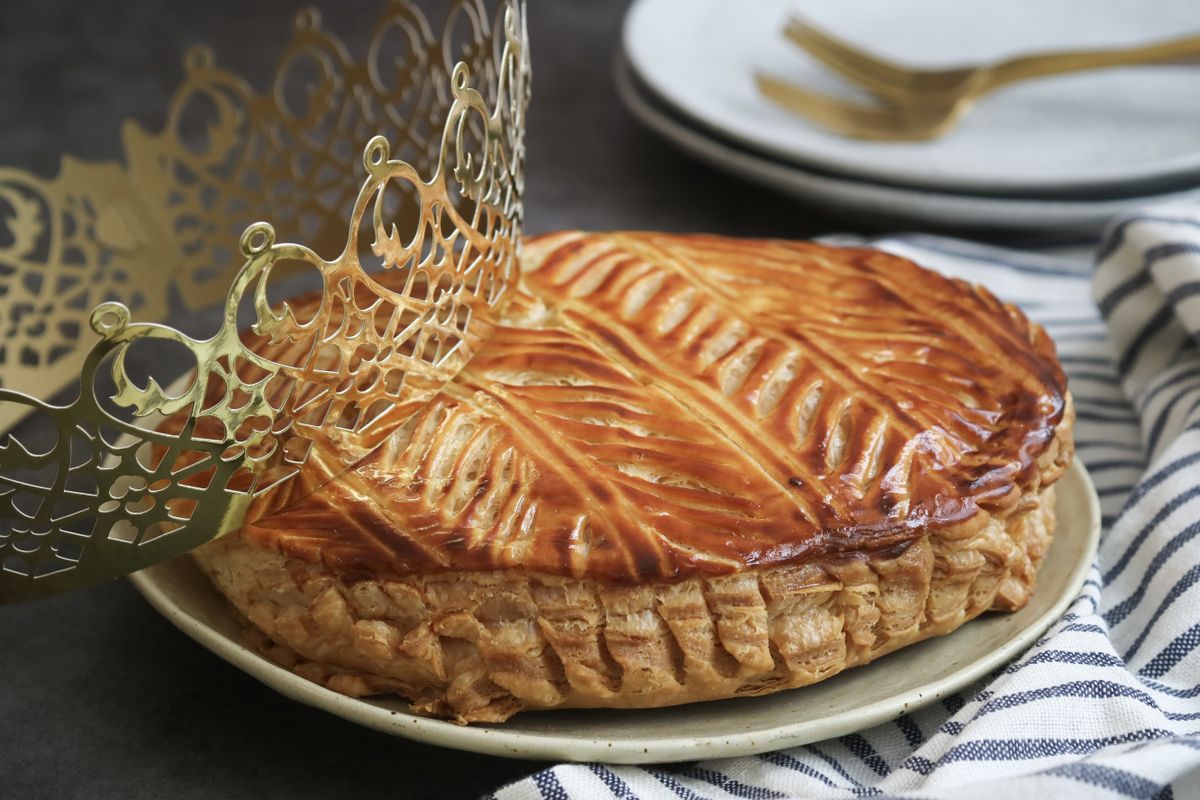
Simply after Christmas yearly, baguettes and croissants transfer out of the highlight in French bakeries (at the very least briefly) to permit the galette des rois—the king cake—to take their place. A puff pastry pie crammed with wealthy frangipane, it’s a pleasant deal with certain to please any fan of marzipan.
However whereas many select their galette for its filling—which these days can run the gamut from plain to pistachio, chocolate to coconut-turmeric—few spend as a lot time fascinated about that the majority emblematic of additives: the fève. (People might know its equal, the “child” hidden inside a New Orleans-style king cake.) Its very presence, in response to custom, designates the “king” of the festivities every January sixth.
American readers might suppose we’ve gotten our dates unsuitable, however that’s no typo: In France, king cake—devoid as it’s of purple, inexperienced, and gold icing—isn’t simply plainer in look than the New Orleans model. French galette additionally stands out in that it’s served, not on Mardi Gras Tuesday, however reasonably on Epiphany, a feast celebrating the arrival of the three smart males on the delivery of Jesus.
Lately, galette season in France has expanded previous the sixth: Any trendy January get-together invitations the presence of a galette. (I personally sampled 10 final January alone.) Earlier than tucking in, custom calls for that the youngest member of the social gathering climb underneath the desk, saying upon whom every slice needs to be bestowed. The one who finds the porcelain fève in his or her piece earns the title of king.
What’s a Fève?
Fèves, as their identify suggests, had been initially easy dried fava beans, used as tokens to designate momentary kings in traditions relationship again to Historic Rome. After all, on this pre-New-Testomony period, fèves had nothing to do with Epiphany. Slightly, in honor of the winter solstice any type of hierarchy was briefly elided, giving even the bottom residents the chance to be designated king by the tiny bean symbolizing imminent spring. Little by little, as with many pagan traditions, the fève grew to become half and parcel with Catholic Epiphany celebrations.
It wasn’t till the Center Ages that the fava bean was changed by a porcelain trinket, a change made, in response to Nationwide Geographic, to scale back the chance of dishonest. Within the 19th century, porcelain fèves had been lengthy imported from Saxony, and in response to passionate fève collector Cyrinne Prudhomme (the girl behind the fève-specific web site, Fabophilie), these intricate, hand-painted fèves rapidly developed from easy bare infants to embody different themes like animals or taking part in playing cards.
The custom practically disappeared in the course of the French Revolution, when secularism started to take maintain and being named a king made you an excellent candidate for the guillotine. In 1793, makes an attempt had been made to forbid the cake altogether, however the French, by no means ones to say no to pastry, largely ignored the regulation. Some baked up “equality” galettes sans fève, and it is this iteration that has been served on the Elysée palace for the reason that time of Valéry Giscard d’Estaing. However for many, fèves soldiered on. After the First World Warfare, their manufacturing was moved native, to Limoges, a metropolis already well-known for its porcelain business. At this time limit, Prudhomme says, “fèves grew to become fairly plain, for lack of time, manpower, and means.”
Limoges however remained the capital of fèves till the center of the 20th century, when plastic collectible figurines slowly started changing the porcelain ones. By 1988, Limoges Castel, the porcelain fève specialist that, at its peak, turned out a number of million fèves a 12 months, had ceased manufacturing altogether.
A Collector’s Merchandise
Prudhomme began her fève assortment within the early 1980s, on the tender age of 5. “The little object was cute and tiny, and we might simply disguise it in our pockets to discreetly commerce with our associates at college,” she remembers.
The need to show her curiosity into a set appeared “solely pure.” Her first fèves, nevertheless, had been “nothing extraordinary,” she says. They had been principally plain white and their form, dimension, and design remained constant through the years.
All that modified in 1989 when, prompted by the bicentennial of the French Revolution, porcelain fèves started their resurgence in France. In 1990, two years after Limoges Castel had ceased manufacturing, Jean-Michel Rojat based Panessiel close to Grenoble, an organization with the objective of preserving the custom of made-in-France fèves. Quickly after, Prudhomme says, well-known pastry cooks “started producing their very own fashions.”
“Some put themselves center-stage by making fèves in their very own picture, or within the picture of their pastry retailers,” says Prudhomme. Others produced toy-like characters to catch the attention of youngsters or engineered ranges like Pierre Hermé’s puzzle items, which inspired customers to finish the set (and thus purchase much more galettes).
“There have been so many who it was unattainable to gather all of them,” Prudhomme remembers.
Artisan Fèves for Artisan Bakers
Whereas in the present day 95 % of fèves are made in Asia, the French market chief Panessiel makes some a million annually and produced its 10 millionth French fève this previous November. It is the fève producer of alternative for a few of French pastry’s most well-known names, together with Pierre Hermé and Cyril Lignac. However some bakers depend on even smaller native producers.
Camille Drozdz and Anthony Bureau are the ceramicists and co-owners of Ici l’Atelier, in La Ciotat, not removed from Marseille. On the behest of a Niçoise chef, they started making their very own fèves just a few years in the past.
“Phrase of mouth did its work, and some purchasers who had seen the items we made for her adopted,” they recall. “The thought of engaged on a sculpture on a small scale seduced us instantly, allying our creativity, our savoir-faire, and that of an artisan baker and pastry chef.”
Above all, Drozdz and Bureau are intrigued by the prospect of propagating this custom in a recent method, crafting distinctive collections for every baker with whom they work. Drozdz remembers her personal Epiphany reminiscences: uniting across the outdated picket desk at her grandmother’s home together with her sisters and cousins.
“The odor of scorching butter within the puff pastry,” remembers Drozdz, “And I, the youngest, underneath the desk proudly calling out who would get each bit.”
Anthony Courteille is the baker behind Paris’ Sain Boulangerie, a bakery recognized for its natural elements and artisan savoir-faire. He too remembers the galettes of his youth. “I beloved it,” he says. “Simply think about: You’re a child; you’re six or seven, and also you’re advised you may be king.”
He bakes two galettes every season: one plain, and one flavored. Final 12 months’s chocolate-hazelnut will this 12 months get replaced by a collaboration with Parisian espresso store La Primary Noire, whose turmeric-scented Golden Paste—normally used as a base for golden milk lattes—can be married with coconut and pineapple. Coirteille’s fèves had been designed by Audrey Giacomini of Giaco Studio in Montreuil, simply outdoors of Paris. Every encompasses a gap, encouraging the finder to repurpose it into earrings or a necklace.
“I believe it’s a disgrace, in our society of over-consumption, that we now not give worth to issues,” says Courteille of his inspiration. “You’ll be able to create a narrative with this object and provides it worth.” Three new fèves resulted from Giacomini and Courteille’s collaboration: a leaf, an almond, and—in a tribute to the trinket’s humble origins—a fava bean.
Have you ever tried a French galette des rois? Tell us your ideas under!
[ad_2]
Supply hyperlink