[ad_1]
I’ve vivid reminiscences of visiting my grandmother’s home as a toddler. I know how so effectively—the precise subway automobile to get off at so we’re closest to the exit stairs, the swirl ice cream machine we at all times move the place I urge my mother for a cone (“simply this one time!”), the right proper flip to make (it’s the second, not the primary or the final). In my reminiscences, we arrive at her gate, the one with big lion-faced metallic door titties with rings of their mouths. I attain out quietly to seize one, realizing as quickly because it creaks her canines will begin barking like mad.
I do know tons of individuals have comparable childhood reminiscences of visiting their grandparents, whether or not it was an extended, cross-country drive or a fast bike trip up the road. However my grandmother, who I noticed each summer time, lived on the opposite aspect of the world.
I’m Korean American, born in Detroit after my mother and father moved from Seoul within the ’80s in order that my dad might attend grad college at Wayne State. Most immigrant youngsters may be break up into two classes: A. You have been born in your house nation and moved as a child, both as a child that’s too younger to recollect your homeland, or throughout your college years, splitting your childhood in two. B. You have been born in America—possibly you by no means actually realized to talk the mom language, save for a number of phrases and cultural contact factors out of your mother and father.
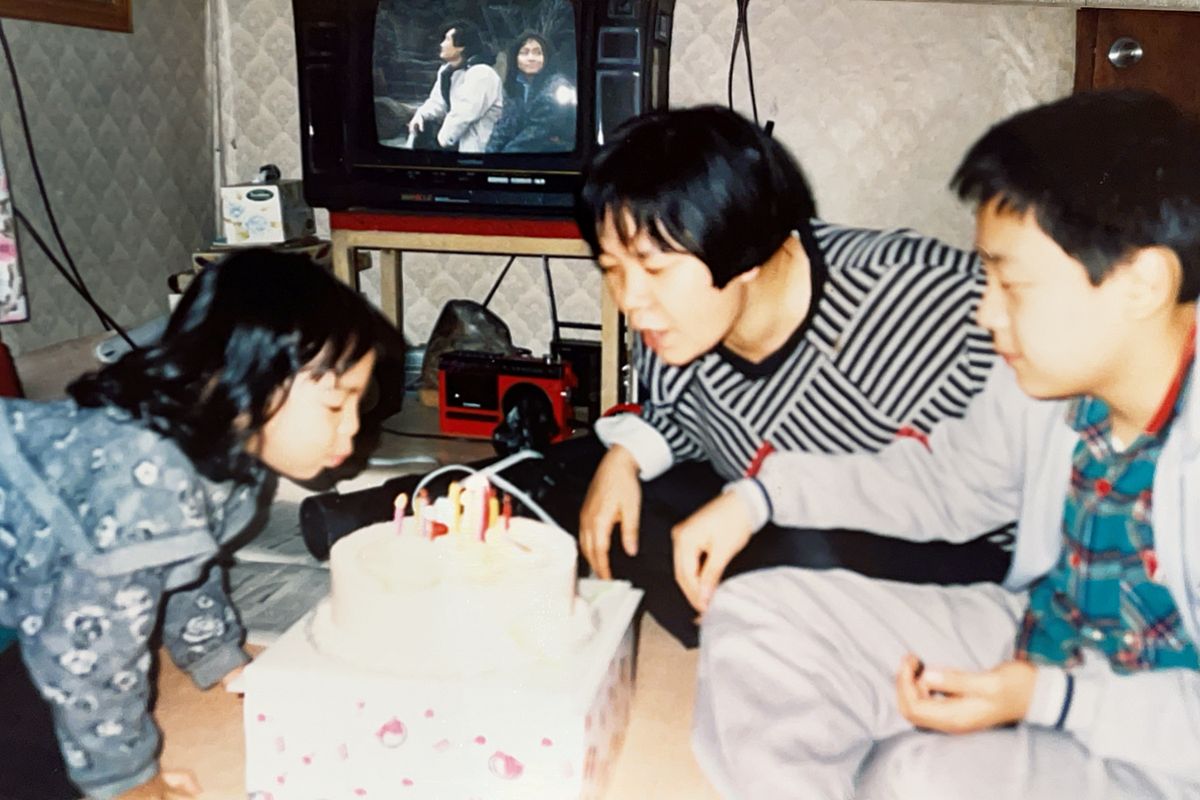
Not like most immigrant youngsters, I skilled two distinct and distinctive childhoods on the identical time. One was decidedly American, the place I attended a super-white, largely Jewish college on the weekdays. The opposite was extra fragmented—Saturdays at Korean college, Sundays at Korean church, weeknights at house consuming my mother’s Korean meals, dinners out in Koreatown, and an annual summer time immersive program in Seoul the place we’d reside at my maternal grandmother’s for 3 months earlier than flying again for the beginning of the following college yr.
Trying again, this was an absolute privilege. My mother and father sacrificed their very own assimilation to make sure their kids’s connection to the homeland. Cross-continental flights carting two younger youngsters and a number of “immigration baggage” (known as thus in Korean as a result of they have been made to stuff all of your life’s possessions) forwards and backwards each summer time weren’t low-cost or straightforward. Each June we whined and begged to remain house, to go to pool events with our associates or an everyday summer time camp. And each September we pleaded to remain in Korea, to have one other play date with our cousins, to maneuver again to the place the folks regarded like us and the meals nourished our souls.
A (Very) Transient Historical past
As I spent each summer time in Korea, I used to be in a position to witness its unbelievable evolution from a poor creating nation reeling from the devastating results of colonialism and warfare to the tradition and tech powerhouse it’s in the present day. Korea’s society was ravaged through the first half of the 20th century by the Japanese occupation. My grandmother was pressured to undertake a Japanese title, communicate and examine solely Japanese in class, and bow on the neighborhood Shinto temple each morning. Erasure of the Korean id was so actual and imminent—who’re we with out our names, our language, our selection of faith and tradition, our meals?
The give up of Japan to Allied forces on the finish of World Warfare II put an finish to Japanese colonial rule in Korea in 1945, however the Korean folks barely had a second to get well earlier than the nation was divided alongside the 38th parallel into two zones managed by the US and the Soviet Union. The Korean Warfare broke out in 1950 as the 2 sides fought for energy over the entire nation, throughout which over Three million folks died, the vast majority of which have been civilians. Amongst them was my grandmother’s oldest sister, who was shot by troopers throughout a stroll again house by the mountains.
Those that survived the warfare endured numerous hardships. My grandmother and her sister fled south together with her sister’s child to flee Seoul, which was captured 4 occasions by communist forces. Individually, my grandfather misplaced ties with most of his household who lived additional north when the 38th parallel was abruptly drawn. By the tenuous armistice that “ended” the Korean Warfare (the nations are nonetheless technically at warfare), South Korea confronted a near-impossible street to restoration. Meals was closely rationed for many years because the nation labored in the direction of social stability and targeted on industrializing and rising its economic system by the remainder of the 20th century. South Korea is now the one members of the United Nations to have been upgraded from the creating economic system group to the developed.
Immigrating Within the ‘80s
By the 1980s, South Korea had recovered sufficient that these in my mother and father’ technology have been extra often attending school, however the extra fascinating alternatives have been overseas: higher training, higher job alternatives, and the American dream. This led to an increase within the variety of Korean infants adopted overseas, international change college students, and immigrants.
My father was one such immigrant. The youngest of 4 kids (two of whom had already immigrated to the U.S.), he immigrated to Detroit for graduate college. Throughout this time, he traveled again to Seoul the place he met and married my mom, who then additionally made the transfer. A yr later I used to be born. We spent most of my childhood transferring across the nation for my dad’s jobs—New York, then Alabama (the place my sister was born), and at last California (the place we finally settled down).

Photograph by Irene Yoo
Korean Meals Recollections By the ‘90s
The Koreans who had immigrated to the U.S., like my mother and father, have been working to determine their very own communities stateside. By the 1990s, the Koreatown in Los Angeles was one such burgeoning neighborhood, anchored by church buildings and eating places that served as assembly grounds for immigrant Koreans and their Korean American kids. Through the college yr, my mother and father would often drive us into city for effervescent pots of soppy tofu at Beverly Soondubu and massive platters of steamed pork stomach ssam at Kobawoo.
Korean immigrants have been additionally confronted with the challenges of recreating meals from house in a brand new nation. My mother, who strived to prepare dinner us Korean meals for each meal at house, would shuttle massive baggage of gochugaru, seaweed, and dried anchovies from our yearly journeys to Korea. The LAX customs brokers have been accustomed to this course of, merely asking “kimchi?” earlier than waving us by. The necessity to adapt to native elements additionally gave rise to new dishes like LA Galbi (which makes use of the flanken-style brief ribs generally present in Mexican supermarkets) and ingenious ideas like all-you-can-eat Korean BBQ (since meat was extra plentiful in America than Korea).
In the meantime, South Korea was lastly experiencing actual financial regrowth as expertise (Samsung, LG) and automobile manufacturing (Kia, Hyundai) corporations boomed. My prolonged household additionally grew, as uncles and aunts married and extra cousins have been born. My mother, additionally the youngest of 4, has an equivalent twin who stayed in Seoul with two youngsters across the identical ages as my sister and me. I believe my twin aunt and her household have been the explanation we traveled again to Korea so usually from such a younger age, the one fixed house port in a sea of recent houses and new faculties.

Photograph by Ty Mecham
Meals was at all times a gathering place for my household. Our presence in Seoul through the summers was a great motive for the entire household to eat collectively. With my maternal grandfather, we might eat naengmyun (chilly buckwheat noodles) a number of occasions every week at eating places like Woo Lae Oak, which nonetheless serves North Korean-style meals in the present day. Naegmyeon was my grandfather’s lifeline to the place and household he was pressured to desert, and it turned my connection to him. A person of few phrases, he’d quietly put together his meal as I watched, including the tiniest drop of vinegar to combine into the broth, slurping his chewy noodles with the meat brisket and cucumber slices earlier than ending off the pear wedges as slightly “dessert.”
Rising up with my grandparents, for whom the traumas of warfare have been nonetheless so actual and current, had an excessive impression on me. Watching them eat was slightly window into their childhoods. It was my maternal halmoni (grandmother) who taught me easy methods to pour scorching water or chilly tea into the dregs of our rice bowls to scrape up each final kernel of rice and drop of sauce. She did this as a child when meals was scarce and grew accustomed to the style. As she aged and fell prey to dementia, it turned the one factor she was in a position to eat.
I adopted their traditions and small rituals in the identical means—the precise development of consuming my noodles, ending my rice with a swirl of scorching water—as if to really feel the way in which they have to’ve felt, and as if my id is also taken away from me at any second. It made me really feel extra Korean to eat like they’d eat, as a result of they have been essentially the most Korean folks I knew: Koreans who had misplaced a lot and fought so exhausting to carry onto their very own id and nationality.
Progress & Transitions Within the ‘00s
The IMF Disaster in 1997 revealed severe points and money owed throughout the nation’s economic system, which triggered an enormous setback in progress as change charges skyrocketed and family incomes plummeted. Koreans felt the squeeze as soon as once more, however the nation recovered from the disaster inside a number of years, resuming its regular after which exponential progress. This was most obvious within the expertise sector—Koreans have been rapidly adopting smartphones, implementing citywide mobile and web networks, and increasing their transportation methods extra rapidly than their American counterparts. I keep in mind using the subway and watching folks watch TV on their telephones (underground) a great 5 to 10 years earlier than this expertise was ever launched in America. It felt like a peek into the long run, like my very personal time machine.
As I aged into that basically enjoyable awkward section often called puberty (chaotic in any tradition), my existence as a Korean started to return into query. I ran highschool monitor in sunny California, which gave me a tan that was stylish in America however met with disdain and racism in Korea. I felt this transition most when settling into the time change upon our June arrivals at my grandmother’s condo. My mother would get up early to set the breakfast desk—this was each her filial function and lease cost whereas we have been dwelling there. By 9 a.m. there’d be a full breakfast unfold of rice, soup, and banchan (aspect dishes). I’d be pulled away from bed bleary-eyed, and the very first thing I’d see was normally the massive beady eye of a broiled croaker, which was unsettling having spent the previous 9 months waking as much as Honey Bunches of Oats earlier than college.
However, my Korean meals training continued to develop, since meals was at all times the middle of focus for our household. Over our full morning unfold of Korean meals, we’d discuss what we should always eat for lunch as we scraped our bowls. My uncle liked to drive us deep into the countryside to eat at a brand new matjip (“tasty home”) he’d heard of from his consuming buddies. I’d go to sleep within the automobile and get up at a duck barbecue restaurant that baked foil-wrapped candy potatoes within the fireplace when you ate for a candy and nutty post-meal snack. As soon as my paternal grandfather handed, we started to often go to his mountainside grave (upon which, per Korean custom, my title can be completely engraved) to provide jesa, including one other new custom of memil guksu and buckwheat pancakes afterwards to our yearly itinerary. I liked going to the si-jang with my halmoni, who’d choose up stacks of soy sauce-marinated crab banchan or baggage of yukgyejang. With my mother, we’d cease on the donut store for a mid-afternoon deal with like old-school kkwabegi and oily crimson bean ppat donuts, or on the bunsik store for a plate of ddukbokki (spicy rice truffles). Our days have been spent filling the time in between meals.
Rediscovering Korean Meals within the 2010s
I finished going to Korea after I was 17, as I ready to go to school. I attended college on the East Coast—far-off from my mother’s home-cooked meals, far-off from L.A.’s Koreatown. I felt like I used to be dwelling an entirely “American” life for the primary time. I didn’t must code change between languages and cultures, and I used to be surrounded by friends who got here from everywhere in the nation, and all all over the world. I didn’t miss Korean meals, and as an alternative I relished in discovering that I liked to prepare dinner. I had risotto for the primary time at one of many many pleasant Italian eating places in Philadelphia, I spent a month cooking carbonara each night time till my physique rebelled, and I baked numerous cheesecakes for my roommates.
I nonetheless didn’t miss Korean meals—not actually—till my first fall dwelling in New York after school. I contracted strep throat a month after transferring and I might barely swallow or preserve something down. I cried on the cellphone to my mother late one night time as a result of the one factor I actually needed to eat was jook, the rice porridge that she and my halmoni would prepare dinner for me every time I used to be sick in Korea. The one place that I knew had it was Woorijip, a small takeaway banchan store in NY’s Koreatown, however I used to be too weak to take the practice, and it felt too wasteful to take a $30 cab on an entry-level wage. “But when that’s what you need to eat, and if that’s what is going to make you are feeling higher, then you must do it,” stated my mother, giving me her maternal inexperienced gentle from 3,00zero miles away. That plastic pint container-full of abalone jook, together with that cellphone name, reframed my relationship with Korean meals as true, therapeutic soul meals.
My curiosity and dedication in rediscovering Korean meals solely grew after that. I began studying extra about its historical past and context by meals popups I began internet hosting underneath the moniker Yooeating, by which I felt like I might lastly share and discuss to others in regards to the Korean meals that I had grown up consuming. Kimchi was not only a smelly lunch field meals (they offered it often on the Korean-owned bodegar close to me), and folks have been beginning to know what gochujang was with out my having so as to add “Korean crimson pepper paste.”

Photograph by Irene Yoo
An Ongoing Journey Between Two International locations
My first journey again to Korea after school was full of trepidation. I hadn’t seen my cousins in years, my grandfathers had handed away, and Korea felt international for the primary time as an alternative of feeling like house. I used to be an grownup now, not only a child tagging together with my mother and father on vacation. I didn’t really feel like I slot in. As I moved by the subways, I used to be a great 4 to 6 inches taller than the folks round me who have been bustling about their day by day lives on their technique to work or college or to satisfy their associates. I couldn’t store in Korea anymore (my mother and aunt’s favourite pastime) as a result of the whole lot was too small for my American shoulders and my American toes.
However, I might nonetheless eat. I spotted that my mother and father had at all times been on their very own journey to rediscover the Korea that they’d left behind, to relive the meals they’d eaten with their getting older mother and father or of their school-age youth. Now, I joined them on this journey. We had naengmyeon for lunch, the place the absence of my grandfather loomed. We sought out haejangguk eating places, despite the fact that my mother and father by no means drank and had nothing to haejang (treatment a hangover), however as a result of we liked how the spicy stew made us sweat. A number of occasions all through the day my dad handled us to a giant bowl of patbingsu (shaved ice with crimson bean), his absolute favourite childhood snack.
It took me many journeys over time to shake that feeling of being a child in Korea, every go to a brand new train in assimilation again into the mom nation. Even after I traveled solo I discovered myself retracing the steps I walked as a toddler, consuming on the decades-old eating places we frequented as a household, reconnecting to that acquainted style. However as I continued to go to Seoul, I felt the town change ever extra quickly with every journey. Neighborhoods sprawled additional away from the town heart, swaths of recent condo complexes sprouted up within the blink of a watch, and social methods just like the subways, card funds, and restaurant bookings modernized quickly. I at all times felt like not fairly a vacationer, not fairly a neighborhood, which can be much like how my mother and father should have felt.
Korean meals and palates have been altering too, changing into sweeter, spicier, and shortly, extra worldly. At first I didn’t need to eat at any of the stylish eating places the place folks have been lining up. However over time I discover myself stress-free, and opening up, to the methods Korea is altering and the methods it may proceed to vary me. Visiting Korea helps me to recollect how I grew up, to immerse myself in Korean language and tradition, and to evolve together with the nation and its folks.
My upbringing between Korea and America had felt like blips in a time machine. I’d pop up a yr later in the identical place and surprise anew the place I used to be, how issues had modified, how I would slot in once more. However my capacity to stroll between these two worlds has additionally led me to turn into an anthropologist of each, in addition to a translator and storyteller, sharing the nuances of my experiences on this great little nation.

Photograph by Irene Yoo
On this most up-to-date journey, whereas I used to be scripting this piece, I journeyed again to my grandmother’s home. I’ve at all times needed to go to once more however had no motive to—I didn’t know anybody there anymore. I took the identical acquainted trains, now extremely modernized and full of commuters, and transferred on the identical station nonetheless full of fish cake and gimbap hawkers. After I obtained off at my grandmother’s station, I used to be struck by how eerily acquainted it was. The swirl ice cream stall was gone, changed by a bakery throughout the identical house. I walked down the steps to the road and the primary intersection regarded the identical: the fruit man was yelling out the day’s specials whereas permed, hunched-over grandmothers (none of them mine) picked by his wares.
Right here, within the coronary heart of my grandmother’s neighborhood, issues nonetheless appeared a lot the identical. However her house was gone, lengthy since demolished to make means for a taller condo constructing. There was no gate, no lion door titties, no canines. As an alternative, I simply stood within the doorway of the reminiscence of my Korean childhood, a great distance from my very own American house, nonetheless a bit trapped within the threshold.
What are your favourite childhood meals reminiscences? Inform us within the feedback!


[ad_2]
Supply hyperlink